
In July 2025, President Trump signed the One Big Beautiful Bill Act (OBBBA) into law, enacting sweeping changes to federal tax and spending policy. Although the OBBBA created 530A accounts, commonly known as Trump Accounts, they were not officially launched until July 4, 2026, one full year after the bill was signed into law.
Overview
Trump Accounts are very similar to individual retirement accounts (IRAs), with one key differentiator; prior to Trump Accounts, an individual would have needed to have earned income to be able to contribute to an IRA. Trump Accounts remove the earned income requirement and allow family members to contribute to a Trump Account for any child under the age of 18 (as of December 31, 2026) with a valid Social Security number. From our perspective, we at Impact Capital are all for any way that allows people to start saving for retirement earlier.
Here are the key features of the accounts:
- Babies born between January 1, 2025 and December 31, 2028 receive a one-time $1,000 contribution from the federal government. Enrollment in this offer is not automatic, so in order to enroll, you will need to file IRS Form 4547 for your child to receive the contribution.
- Families can contribute up to $5,000 per year per child. It is crucial to note that this is not a situation where parents and grandparents can each give $5,000; the maximum contribution from all sources within the same family is capped at $5,000 per child each year.
- The $5,000 contribution limit will be indexed for inflation starting in 2028.
- Contributions for a given calendar year must be made by December 31 of said calendar year unlike standard IRAs, which allow contributions to be made until April of the following year.
- There are no upfront tax breaks for individuals who fund Trump Accounts; individual contributions are made on an after-tax basis.
- Employers can contribute up to $2,500 per year per employee.
- The funds are invested in low-cost (0.10%) mutual funds or exchange-traded funds that track the S&P 500 index or a similar index.
- The account grows on a tax-deferred basis.
- No account withdrawals are permitted until the child is 18.
- When the child turns 18, the account can be converted into a standard IRA.
- To open the account, go to trumpaccounts.gov and download the official app.
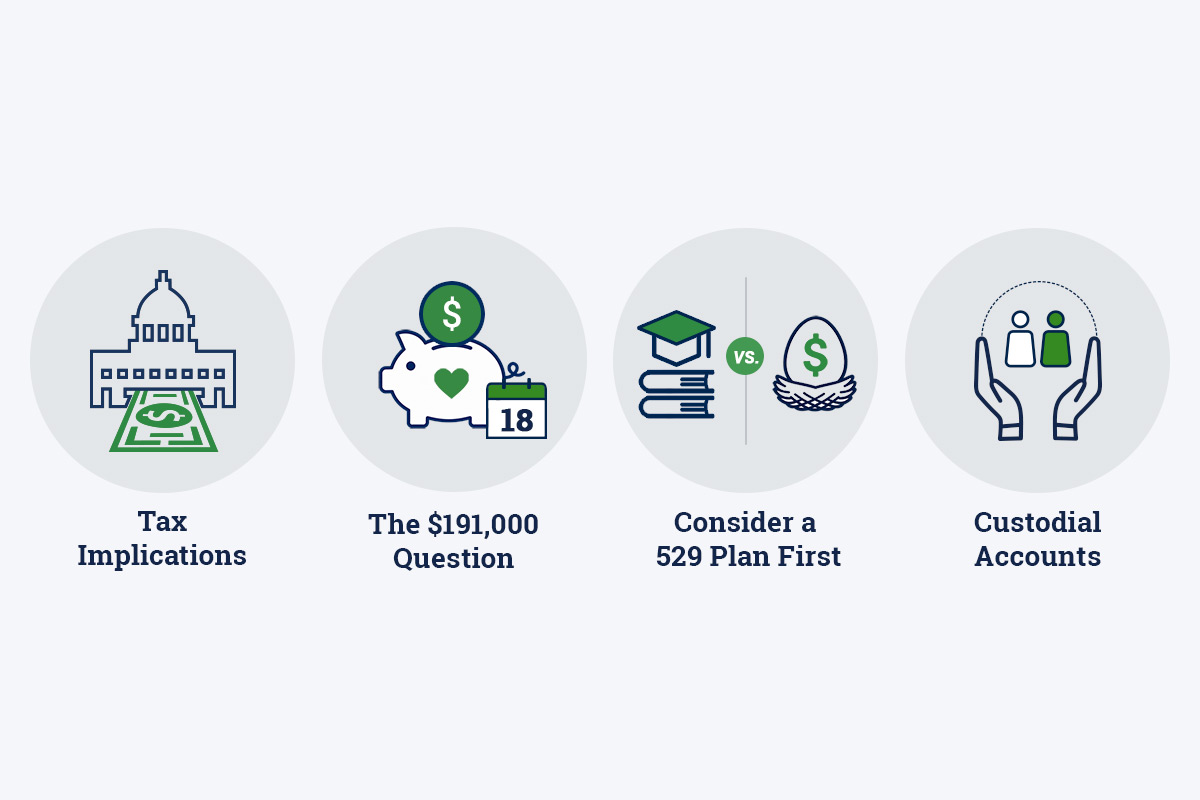
Tax Implications to Take Into Consideration
They say that too much of a good thing is a bad thing, and high taxes are indeed the biggest downside of the Trump Accounts. These accounts are meant to be used for retirement, and while decades of tax-deferred growth may sound great, all that growth will eventually have to be taxed – and most of it will be taxed as ordinary income.
Upon reaching the age of 18, the Trump Account will be owned by the child, and with it come the responsibilities for the tax implications, which means the “kiddie tax” rules apply. The kiddie tax rules are a special set of rules that apply to unearned income received by children who are either: under the age 18; don’t have enough earned income to provide half of their own support at age 18; or are a full-time student who doesn’t have enough earned income to provide for half of their own support.
- The rules allow the first $1,350 of unearned income to be tax-free.
- The next $1,350 of unearned income is taxed at the child’s tax rate (likely zero).
- Any income exceeding $2,700 is taxed at the child’s parent’s income tax rate.
The accounts will be made up of after-tax contributions and (hopefully) investment gains that have never been taxed before. Withdrawals will follow the standard IRA withdrawal rules, with each withdrawal being partially tax-free and partially taxable based on the pro-rata amount of the after-tax contributions and the pre-tax gains.
Just like with IRAs, withdrawals from Trump Accounts before age 59.5 will be subject to ordinary income tax and also incur a 10% penalty. First-time home purchases, starting a business, and qualifying college expenses are subject to ordinary income tax but avoid the 10% penalty.
The $191,000 Question
There is also a big question you need to ask yourself: Do you trust your 18-year-old child with an account that is worth $191,000? Assuming the Trump Account was opened in 2026 with the government’s free $1,000, the annual $5,000 contributions were made, and the account grew at a rate of 6% per year, the Trump Account would be worth an estimated $191,000 when the child turns 18. At that time, they are free to do with that money as they wish. Yikes!
Consider a 529 Plan First
Something to keep in mind while tax planning for your child’s future is that a 529 plan has some advantages over Trump Accounts. Granted, a 529 plan is designed to help pay for college (or high school), while Trump Accounts are designed for retirement. That being said, 529 plans offer tax-free growth (versus tax-deferred) when the proceeds are used for higher education. Additionally, the 529 plan owner controls the account, not the child. Up to $35,000 of the 529 plan can be rolled over to a Roth IRA, which would grow tax-free for retirement. For these reasons, setting up a 529 plan is our first recommended course of action for families looking to help their younger generation get ahead.
Custodial Accounts: Another Viable Option
Finally, the other types of accounts to consider opening for your child would be an UGMA or UTMA, which are taxable brokerage accounts managed by an adult until the child reaches the age of majority. While there are no contribution limits, the taxes are determined by the kiddie tax rules, which allow up to $2,700 of capital gains to be realized before the child turns 18 each year. The result of harvesting gains would be to raise the cost basis in the custodial account over time. When the child reaches the age of majority, the potential tax implications are lower than those of the Trump Accounts, which do not offer the capability to harvest gains before age 18.
Choices, Choices, and More Choices
Each of these accounts – Trump Accounts, 529 plans, and custodial accounts – helps the beneficiary in different ways. While it can be overwhelming to have so many to choose from, having more choices allows you to customize your financial planning goals in your own way. Should you have any questions, please do not hesitate to contact your Impact Capital advisor.
STAY IN THE LOOP