
Impact Capital’s quarterly research report seeks to highlight the latest developments most relevant to your investments and financial planning. In the latest installment of Impact Capital’s Three Market Themes quarterly research report, we focus on the performance of the “Magnificent Seven” stocks, small capitalization stocks, and an updated look at federal interest rates.
1. The Magnificent Seven: Mag-7 or Lag-7?
For the last few years, beating the market was as simple as owning a group of seven stocks, dubbed the Magnificent Seven: Nvidia (NVDA), Apple (AAPL), Microsoft (MSFT), Amazon (AMZN), Alphabet (GOOG), Meta (META), and Tesla (TSLA). These are incredible businesses, but widespread, growing concerns over their possible overinvestment in artificial intelligence has hurt the stocks since late October 2025. The chart below shows the S&P 500 has earned 10% since late October while the Magnificent Seven have lost 1% over the same time frame.
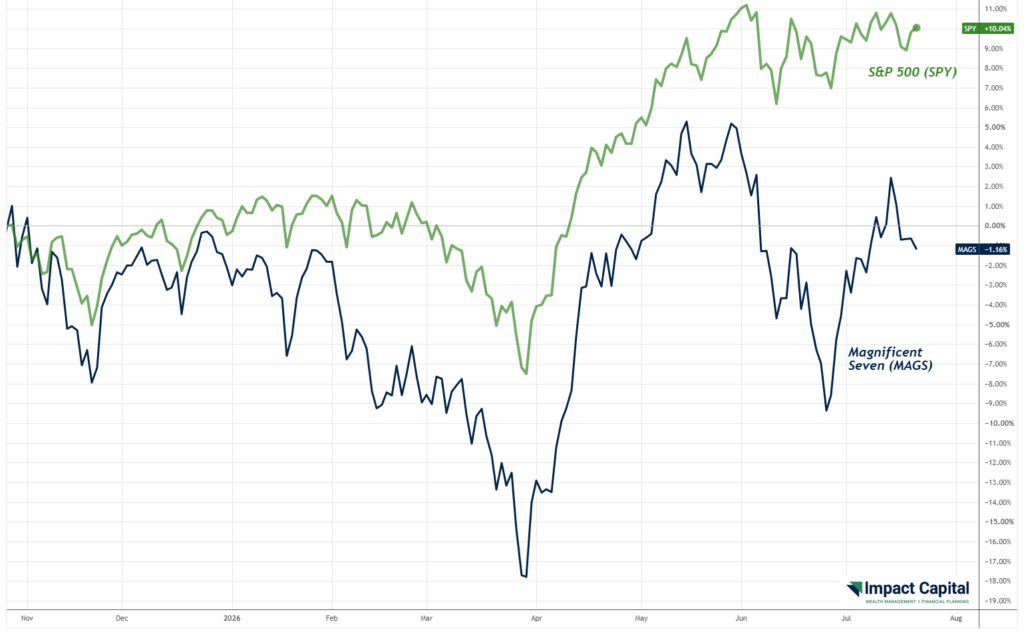
The stock market will do whatever will confound the majority of investors. This isn’t to say the Magnificent Seven stocks won’t do well in the future. The future is unknowable, but it is natural for the stock market to reward different stocks over time – the only constant is change. For context, the largest stock in the S&P 500 was Exxon Mobil (XOM) twenty years ago, with Microsoft being the only one of the Magnificent Seven in the top ten holdings back then.
Rather than try to predict the unknowable, ever-changing future, a better approach is to own the market. Part of the benefit in owning the S&P 500 is that the stocks that are outperforming will gain a larger weighting in the index, and the best part is that this is done for you automatically. You didn’t have to know Exxon Mobil was going to underperform, or that Nvidia was going to outperform in the last five years. In addition, owning the market often results in lower fees and is more tax efficient than actively managed funds.
2. Good Things Come in Small Packages
If the largest stocks haven’t been carrying the stock market to new highs, which stocks have been doing the heavy lifting? Small Cap stocks. The Russell 3000 is an index, similar to the S&P 500, that tracks the 3,000 largest U.S. publicly traded companies. The smallest 2,000 of those 3,000 stocks is captured in another index called the Russell 2000 index. The chart below shows the Russell 2000 index has earned 19% since last October, beating the S&P 500’s 10% return over the same period.
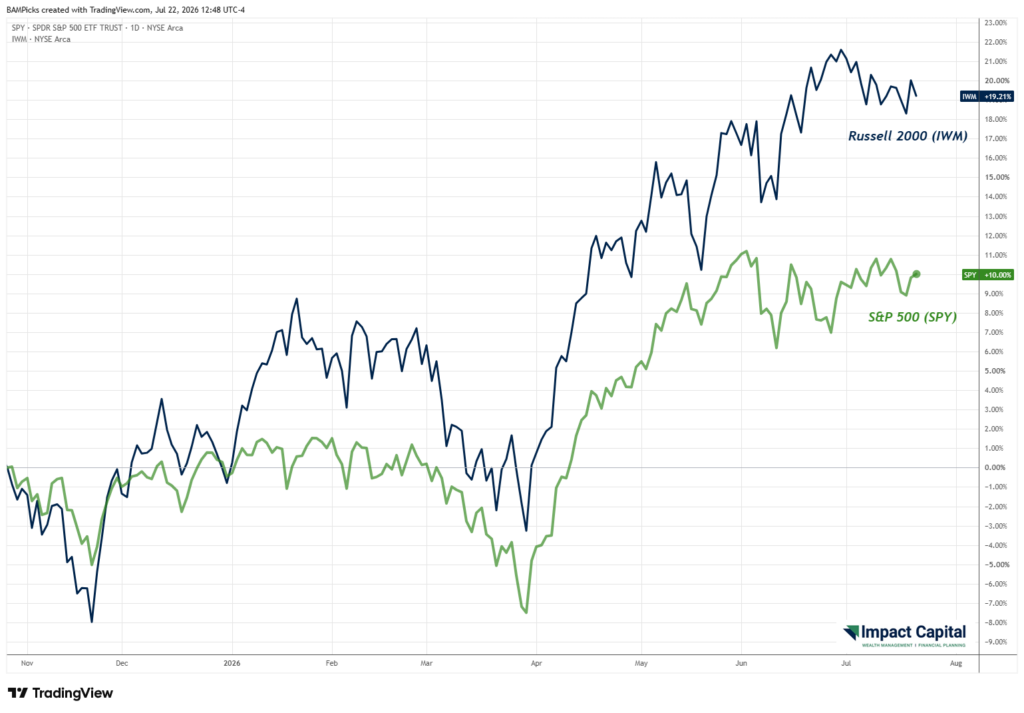
Since smaller companies often have less diversified business lines, they tend to be more economically sensitive. When the Russell 2000 is performing well, it is seen as confirmation of the strength in the underlying economy.
Just for fun: Here is a list of ten stocks. Five of them are in the top ten holdings of the Russell 2000. I made up the other five. Can you tell which ones are real?
| Moog Inc. | Ruby Inc. | Old National Bancorp | Viasat Inc. | Louie Dowd & Co. |
| Maizy Corp. | YOLO Inc. | John Williams Drilling | Hut Corp. | CytoKinetics, Inc. |
3. An Updated Look at Interest Rates
Kevin Warsh, the new Chairman of the Federal Reserve, testified to lawmakers earlier this month that the Federal Reserve will bring inflation down, saying members of its rate-setting committee “have no tolerance for persistently elevated inflation.” The greatest challenge currently facing the Fed is that prices have remained higher for longer than expected.
One main risk of investing in bonds is inflation. You wouldn’t want to loan someone money and then be paid back with money that has depreciated in value. For that reason alone, the bond market is sensitive to inflation.
No one asked me if I wanted to be Chairman of the Federal Reserve. However, if they did, I would use the collective wisdom of the markets to dictate interest rates. The yield on the two-year Treasury note is how the market predicts future changes in interest rates. The chart below appears to show the two-year yield changing directions before the Federal Reserve follows suit.
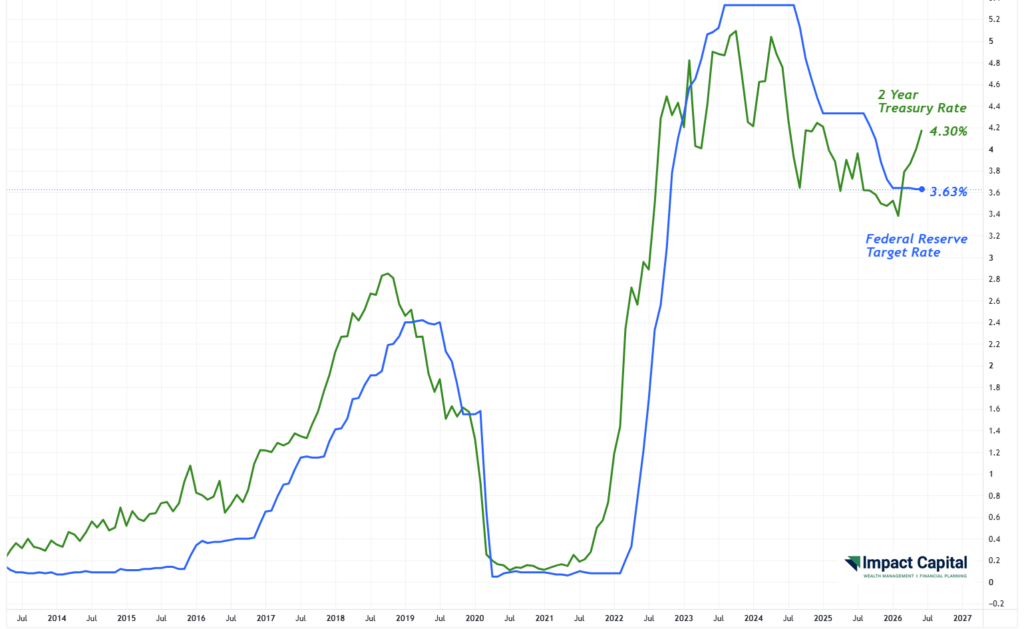
What’s noteworthy now is the two-year Treasury note is predicting the Federal Reserve will have to raise interest rates by 0.50% or 0.75% in the next two years. There is no guarantee this is what the Fed will do. In fact, the two-year yield could always come back down before the Fed changes anything. That said, like the Federal Open Market Committee, we will continue to monitor the market and adjust our guidance as new developments unfold.
STAY IN THE LOOP